
Policy Surveillance 101: Finding dates

There are at least two dates you can consider when evaluating a law for a policy surveillance or legal epidemiology project:
Enactment date: The date a law is passed. Also called approval date, passage date, or signature date.
Effective date: The date a law goes into effect. This is when the government's responsibility to grant a right or benefit or its power to enforce a law begins.
At the federal level:
Statutes are generally effective on their enactment date. If these are different, the statute “will almost always include an effective date note under the [its] section.”
A regulation does not become effective until at least 30 days after the publication of the Final Rule in the Federal Register, “unless it grants an exemption, relieves a restriction, or for “good cause,” which includes such things as emergencies.”
(A quick overview of the difference between statutes and regulations.)
At the state level:
Statutes often have different enactment and effective dates. If an effective date is specified in the text of the bill or statute, that controls. However, in the absence of a specified date, states have default effective dates. Sometimes these are simply a certain number of days after passage or governor’s signature or set dates, sometimes these are based around the dates of legislative sessions.
The National Conference of State Legislatures has tables of dates for regular and (if applicable) special legislative sessions across all states starting in 2019.
Legiscan has a table of how long governors have to sign a bill into law both during and after legislative sessions with defaults for what happens to a bill that a governor does not sign.
Regulations are generally published in a state regulatory notice register that is the equivalent of the Federal Register. This UCLA Law libguide links to state regulatory notice registers where available. The gap between passage and effective date varies between states.
Here is an example of how you would determine these dates for one state regulation, starting with an electronic version from Bloomberg Law:

At the bottom of the page, after the text, you will see a couple of references. These are to the regulatory history--where it appears in the Delaware Register of Regulations. (These may not be complete, as you’ll see below.) A version of this regulation was promulgated in 2020, but let’s say we’re concerned with the 2021 changes for now. If you follow the link in the libguide to the Monthly Register of Regulations, then look for Volume 25 in the previous issues, you’ll find that September 1 was Issue 3. Opening this file and going to page 285 shows:
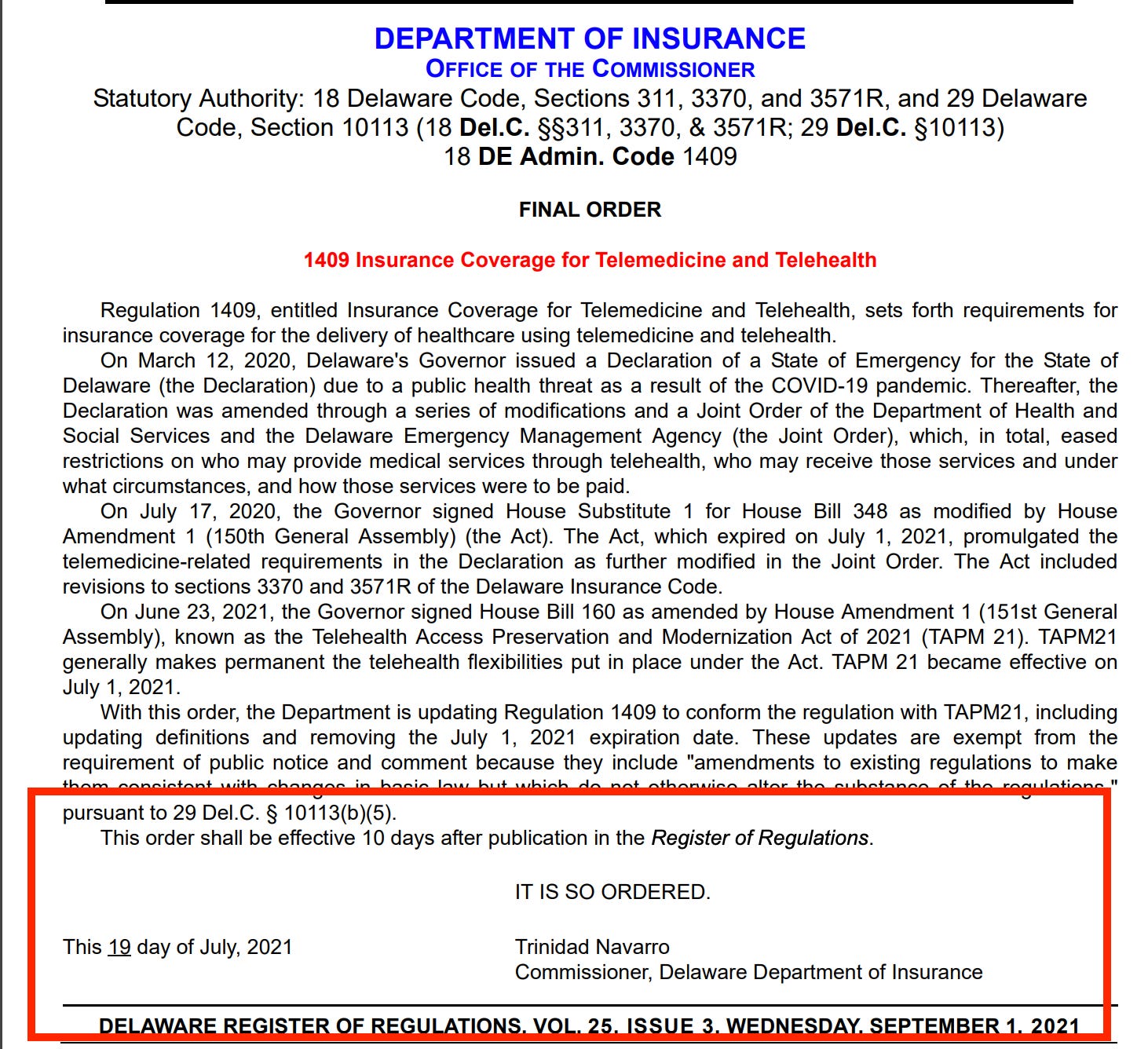
The head of the agency responsible for this regulation signed the order promulgating it on July 19, 2021, this would be the enacted date.
These changes to the regulation became effective 10 days after publication: September 11, 2021. Unless specified as business days, “days” generally means calendar days, but if you wanted to check, Delaware’s rulemaking regulations make clear “The earliest effective date is the 11th of the month of publication of the final regulation.”
There may be additional relevant dates for some laws. These may be fixed dates (a firm date, e.g., March 28, 2023) or contingent dates (see the Maine example below):
Operational date: Some laws state explicitly in their text that they will not be implemented until some date in the future. The date when the directives of the statute may be actually implemented is the operational date, also called operative date. California explicitly has an Attorney General Opinion allowing for operative dates for statutes, but they can exist for any kind of law in any jurisdiction.
End date: Some laws are set up as pilots or temporary laws and these will explicitly have an end date. Can also be called a “termination” or “sunset” date. These were very common in governor’s executive orders during the COVID emergency, such as this one from Maine that provides it “shall remain in effect until rescinded or until the State of Civil Emergency to Protect Public Health is terminated, whichever occurs first.”
The Delaware regulation we looked at provides another example of an end date (note that Delaware also gives a markup version of the regulation showing changes, which is very helpful!):
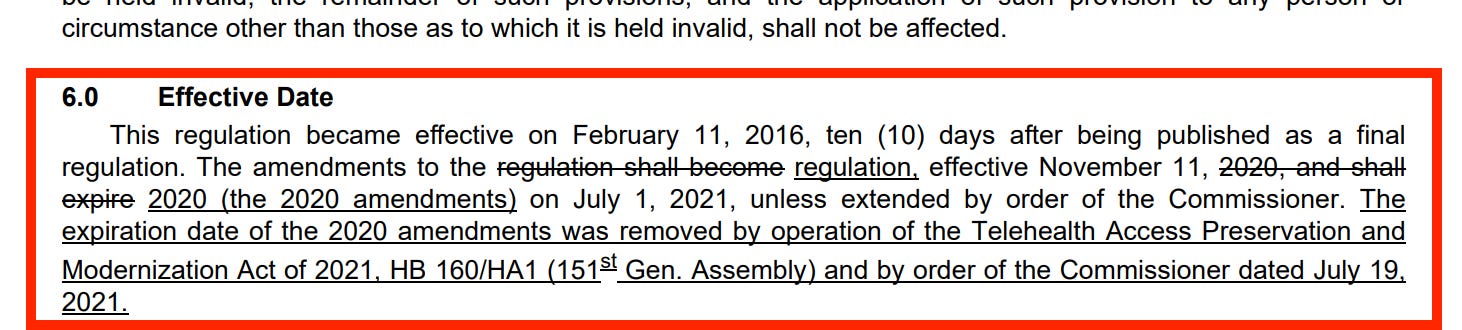
From this we can see a couple of things--first, the original 2016 issuance that promulgated the regulation is missing from the history in the electronic version we started with. Based on the effective date of February 11, the first place I checked was the February 1, 2016 register, and the regulation was first promulgated there. (See page 768.)
We can also see that the 2020 amendments were set to expire July 1, 2021, but they were extended, first by a statute and then by the agency.
Temple’s Center for Public Health Law Research recommends generally using effective dates. This is reasonable as long as you assume that the signaling function of a law’s passage has minimal effect. Given that people regulated by a law may not know about or understand it even when it has been in effect for years, that’s going to be true most of the time, but there may be times when it’s appropriate to use the enacted date or when you may want to compare results from both dates. Where operational dates or end dates exist, they will be relevant to most research questions. Determining these dates may require outside research as they may depend on facts outside the law itself. For example, if the start of a program is contingent on funding, you will need to determine if the funding was granted.
Once you’ve made a choice about which date(s) to use, “it is critical that the choices are transparent.” (Page 9 walks through an example of choice of dates for one state’s law.) From experience, I’d recommend gathering as many of the dates as possible when coding laws, even if they won’t be used for your immediate project. These kind of projects invariably go on for years, and often generate more than one paper or project. It’s much easier to record an additional date or two when coding than it is to go back to retrieving the laws and looking for them later.